No products in the cart.
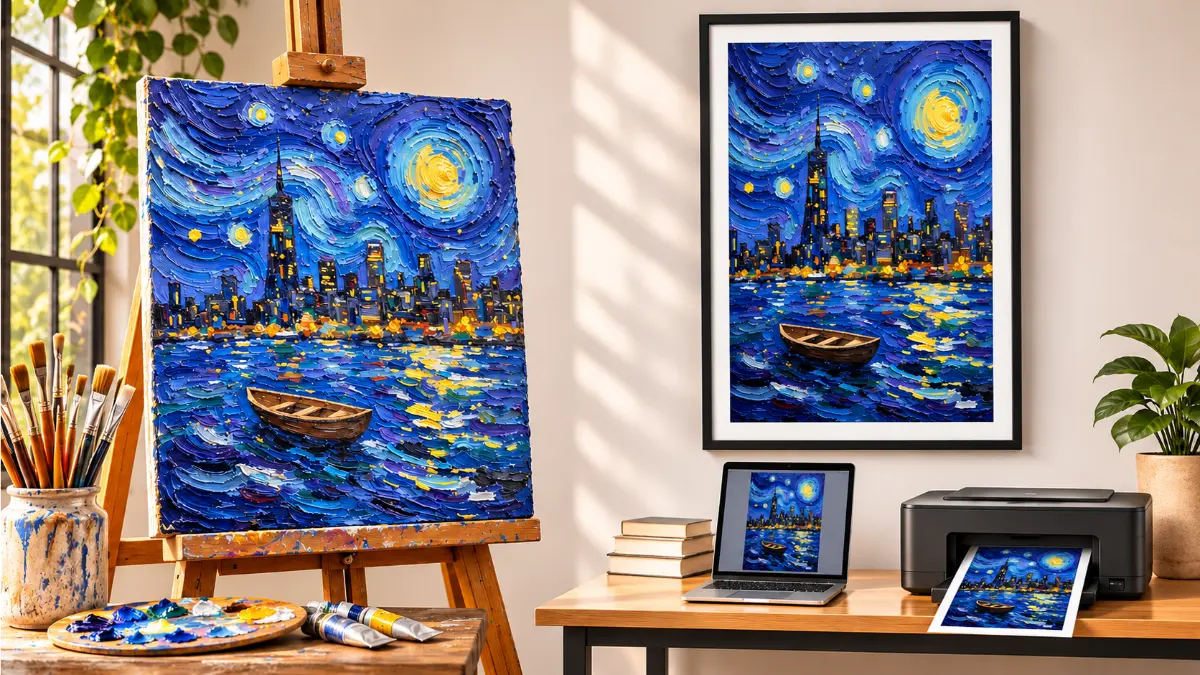
If you’re decorating a home, at some point you’ll probably find yourself torn between two very different options. Do you save up for an original piece of art, or do you go for a digital print you can download today? It’s a question a lot of people wrestle with, and there isn’t one right answer.
As someone who works with art every day, I’ll be upfront: both have something genuinely special to offer. The trick is understanding what you’re actually paying for with each, then matching that to your budget, your space and how you live. Let’s break it down honestly.
What Is Original Art?
Original art is a one-of-a-kind piece made directly by the artist. A painting on canvas, a charcoal drawing, a hand-pulled print, a watercolour. There’s only one of it in the world, and when you buy it, it’s yours alone.
That uniqueness is a big part of the appeal. You can see the texture of the brushstrokes, the slight imperfections, the places where the artist changed their mind. There’s a real human story behind it, and many people love knowing they’ve directly supported an artist.
Some original pieces also hold or grow in value over time, particularly from established artists. That said, most people buy originals because they love them, not as an investment.
What Is Digital Art?
Digital wall art is artwork delivered as a high-resolution file. You download it, then print it at home or through a print lab, and frame it however you like. It might be created entirely on a computer, or it could be a scan or digital version of a hand-made piece.
Instead of buying a single physical object, you’re buying the right to print and display the artwork. With SliqArt, that means you can print it as many times as you need for your own spaces. If you’d like the full rundown, our beginner’s guide to what digital wall art is covers it step by step.
The Key Differences
Here’s a quick side-by-side look at how the two compare.
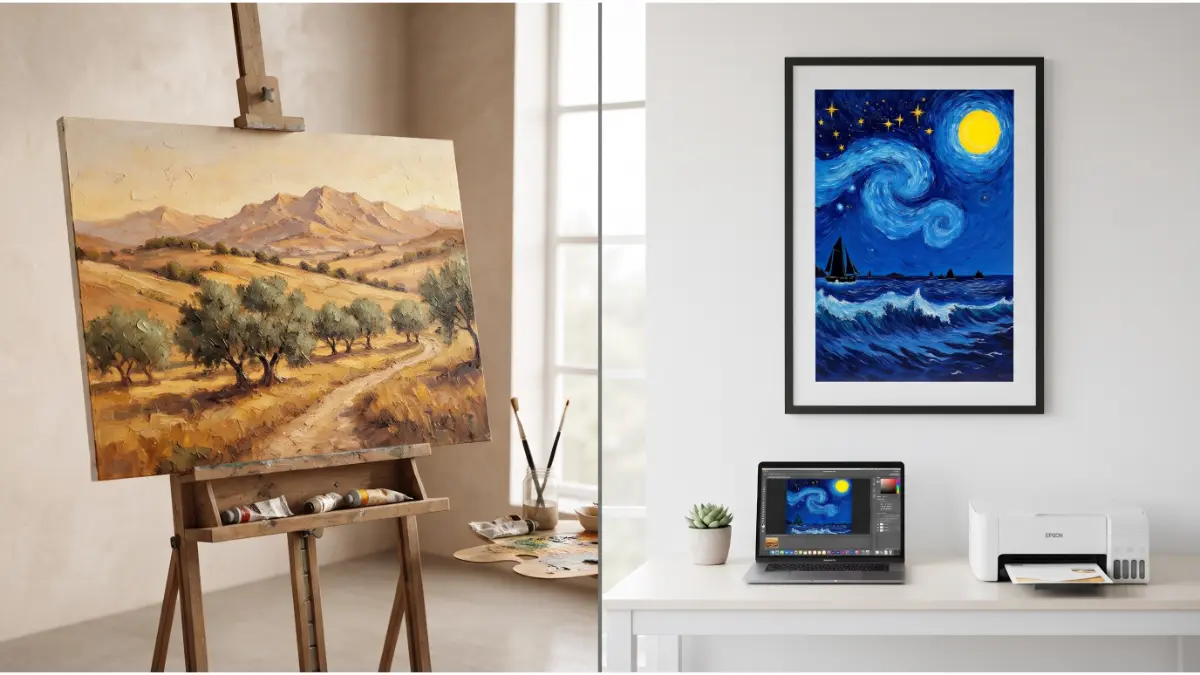
Price. Original art can range from a few hundred to many thousands, depending on the artist and size. Digital art costs a small fraction of that, which makes it far easier on the wallet.
Uniqueness. An original is one of a kind. A digital print isn’t exclusive, though the way you size, print and frame it makes it feel personal to your space.
Size flexibility. An original comes in one fixed size. A digital file can be printed small, large or anywhere in between.
Speed. Originals may need to be shipped, sometimes from far away, and shipping large framed pieces can be expensive. Digital art arrives in your inbox within minutes.
Replacement. If an original is damaged, it’s gone for good. If a digital print gets stained or faded, you simply print another copy.
Texture and presence. This is where originals win. Nothing quite matches the physical texture of paint on canvas.
When to Buy Original Art
An original piece makes a lot of sense in certain situations.
- You’ve found a piece that genuinely moves you, and you know you’ll love it for years.
- You want a true one-off statement for a key spot, like above the fireplace or in the entrance.
- You care deeply about supporting a specific artist directly.
- You enjoy collecting and want pieces with history and texture.
- You’ve got the budget and you’re not planning to change your décor any time soon.
If that sounds like you, an original can become a treasured part of your home. Just remember to factor in framing, which for larger canvases or works on paper can add quite a bit to the cost.
When Digital Art Is the Better Choice
For a lot of people, digital art is simply the more practical option, and there’s nothing second-best about that.
- You’re decorating a whole home and need several pieces without blowing the budget.
- You rent, move often, or like to switch things up with the seasons.
- You need a specific size to fit an awkward wall or an existing frame.
- You want something on the walls this weekend, not in three weeks.
- You’re decorating a kids’ room, a holiday rental or an office where things might get knocked about.
Digital art also takes the pressure off. When a piece doesn’t cost much, you can take a chance on a bold colour or an unusual style, like a vivid Lighthouse Sunset Impasto in a hallway. If it doesn’t work, you haven’t lost much.
Can Digital Art Look as Good as a Physical Print?
This is the question people ask most, and the honest answer is yes, as long as you print it well.
A high-resolution file, printed on good paper with archival pigment inks, looks crisp and professional on the wall. In fact, many prints sold framed in shops are produced the same way: a digital file, a printer and paper. Most guests won’t be able to tell the difference.
A few things make all the difference:
- Start with a high-resolution file. All SliqArt files are sized for sharp prints at our largest sizes.
- Choose decent paper. Matte fine-art paper looks soft and gallery-like, while glossy paper makes colours pop.
- Use a print lab for bigger sizes, roughly 16 × 20 inches and above.
- Frame it properly. A mat and a good frame make any print look more finished.
Our guide to framing digital art prints has plenty more detail if you want to get it just right.
The Practical Middle Ground
Here’s the thing: you don’t have to pick a side. Plenty of the nicest homes mix both.
The approach I recommend most is to invest in one original for the spot that matters most, then fill the rest of your walls with well-chosen digital prints. Painterly styles like our nature and landscape art sit comfortably beside an original canvas. Our room-by-room guide can help you decide where each piece goes.
Digital art can also be a great way to test your taste. Live with a style for a while in print form. If you still love it a year later, that’s a pretty good sign it’s worth hunting down an original in a similar style.
So, Which Should You Buy?
If you’ve got your heart set on a particular piece and the budget to match, go for the original. If you want to fill your home with art you love, without the big price tag or the long wait, digital is a smart, flexible choice.
And if you’re leaning digital, you’re in the right place. Browse the SliqArt collection, or start with wildlife and animal art and coastal prints, and see what speaks to you.
Frequently Asked Questions
Is digital art cheaper than original art?
Yes, usually by a wide margin. You pay once for the file and choose your own printing and framing budget.
Can people tell a digital print from an original?
Rarely. A high-resolution file printed with pigment inks on good paper looks crisp and professional.
Does original art hold its value?
Some does, but most people buy art because they love it, not as an investment.
Comments are closed