No products in the cart.

Here’s something nobody tells you when you buy your first piece of wall art: the size matters almost as much as the picture. You can find a print you love, frame it beautifully, hang it up, and then step back and feel like something’s off. Nine times out of ten, the problem isn’t the art. It’s the size.
Of all the questions we get about wall art, sizing comes up the most, and the mistake is almost always the same: going too small. A print that’s undersized looks lost, like a postage stamp on a big envelope. You don’t need a designer’s eye to avoid it. You need a few proportions that designers and framers have relied on for decades.
Start With the Wall, Not the Artwork
It’s tempting to fall in love with a piece first and then figure out where it’ll go. Totally understandable. But if you want the art to look like it belongs, flip the order around and look at the wall first.
Grab a tape measure and jot down a few things:
- The full width and height of the wall
- The width of any furniture against it (a sofa, bed, sideboard or desk)
- Anything that breaks up the space, like light switches, windows, plug points or a TV
Those numbers will tell you far more about what to buy than scrolling through product photos ever will. A wall above a three-seater couch needs something very different from the narrow strip beside your front door.
The 60 to 75 Percent Rule
If you only remember one thing from this post, make it this. When you’re hanging art above furniture, the artwork should cover roughly 60 to 75 percent of the furniture’s width.
So say your sofa is 2 metres wide. You’d want your art, or your group of prints, to span somewhere between 1.2 and 1.5 metres in total. That proportion makes the art and the furniture feel like one arrangement instead of two separate things that happen to share a wall.
Go much narrower and the art looks like an afterthought. Go wider than the furniture and it feels like it’s spilling over the edges. You can bend the rule, but it’s a really reliable starting point.
On a bare wall with nothing in front of it, think about the wall itself. A single print on a big empty wall usually needs to be large, or you’ll want to group a few pieces so they fill the space as one unit.
Standard Print Sizes at a Glance
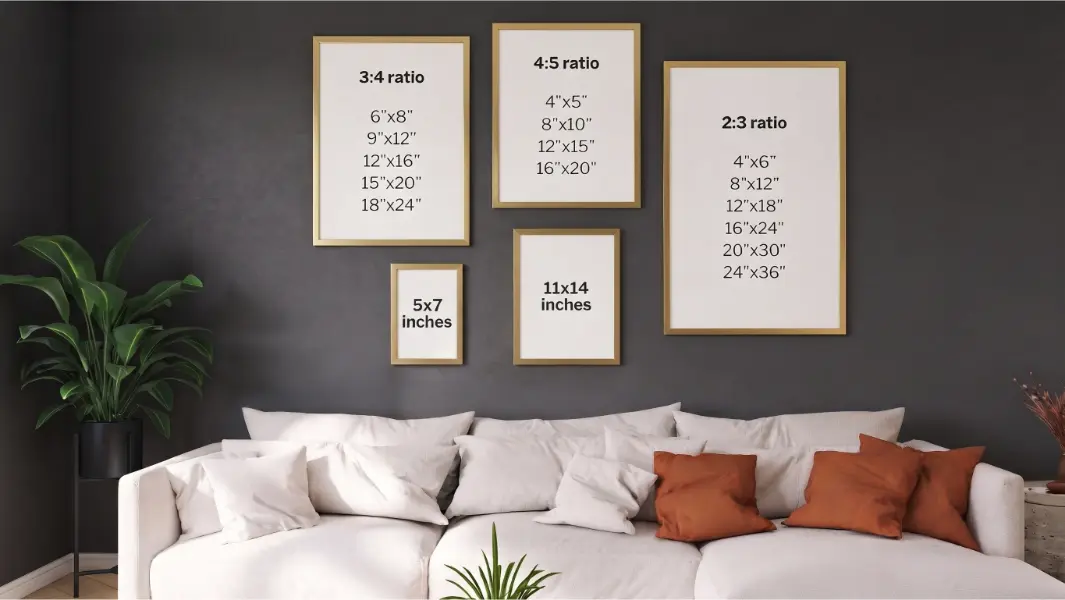
Here’s the cheat sheet I’d give any client. One thing worth knowing first: sizes belong to different aspect ratios. 8 × 10 and 16 × 20 are 4:5, 12 × 16 and 18 × 24 are 3:4, 4 × 6 and 24 × 36 are 2:3, and A-sizes follow their own ratio. Printing a file at a ratio it wasn’t made for means cropping, so always check the ratios listed on the product page before you choose a frame.
| Print Size (in) | Best For | Typical Use |
|---|---|---|
| 4 × 6 | Small accents, desks | Tabletop frame |
| 5 × 7 | Side tables, small walls | Desk or shelf |
| 8 × 10 | Bedrooms, hallways | Standard wall art |
| 8.5 × 11 | Home office, study nooks | Roughly A4 |
| 11 × 14 | Side walls, dining rooms | Popular gallery size |
| 12 × 16 | Medium accent walls | Medium wall art |
| 16 × 20 | Feature walls, above sofas | Statement piece |
| 18 × 24 | Stairwells, tall spaces | Poster size |
| 20 × 24 | Living room centrepieces | Gallery wall anchor |
| 24 × 36 | Entrances, large walls | Maximum impact |
If you’re stuck between two sizes, go bigger. Small pieces like our Minimalist Watercolor Abstract Circles are perfect on a shelf or desk, but on an open wall a bold piece such as the Vibrant Lighthouse Sunset Impasto printed at 24 × 36 will hold the space far better.
Try Before You Commit
This is the trick that saves people the most regret. Before you print or buy a frame, cut a piece of paper or cardboard to the size you’re thinking about. Stick it to the wall with painter’s tape and leave it there for a day or two.
Walk past it. Sit on the couch and look at it. Check it in morning and evening light. It’s the same trick professional stylists use, and it costs nothing.
Getting the Hanging Height Right
Even the perfect size can look wrong at the wrong height. The most common mistake? Hanging art way too high, almost touching the ceiling, as if it’s trying to escape.
A good rule of thumb is to place the centre of the artwork at eye level, which works out to about 145 to 150 cm from the floor. Galleries use roughly the same height, and there’s a reason for it. It just feels natural to look at.
In rooms where you mostly sit, like a living or dining room, drop that by 10 to 15 cm. That way the art relates to the people in the room rather than floating above their heads.
Hanging Above Furniture
When you hang art over a sofa, bed or console table, aim for about 15 to 25 cm between the top of the furniture and the bottom of the frame.
Any more feels disconnected; any less looks cramped. Above a bed, measure from the top of the headboard rather than the mattress.
Sizing a Gallery Wall
Gallery walls follow the same logic, just with more pieces. Treat the whole group as one big artwork, so the combined width should still land in that 60 to 75 percent range when it’s above furniture.
Mixing sizes is what makes a gallery wall look curated instead of cluttered. An easy formula is one large anchor piece, 16 × 20 or bigger, with two to four smaller prints around it. Keep the gaps between frames consistent, around 5 to 8 cm, and it’ll hang together nicely even if the frames differ.
For more on layouts and spacing, our step-by-step gallery wall guide walks through the whole process.
Why Digital Art Makes This Easier
Every SliqArt print comes as a high-resolution digital file, so you’re not locked into one size at checkout. A useful rule from the print trade: aim for around 300 pixels per inch for pieces viewed up close, while large posters seen from across a room can look sharp at lower densities. Our files are sized with that in mind, from desk prints up to 24 × 36. Not sure how to print yours? Our guide to digital wall art covers home printing and print labs.
Not sure? Start smaller, see how it looks, and if you want it bigger, just print it again. Same artwork, no extra cost.
Take your measurements, try the paper trick, and then browse our full digital wall art collection to find a piece that fits your wall just right.
Frequently Asked Questions
What size art goes above a sofa?
About 60 to 75 percent of the sofa’s width.
How high should I hang art?
Centre it about 145 to 150 cm from the floor.
Can I print one file at different sizes?
Yes, as long as the size matches an aspect ratio included with your file.

This website uses cookies to improve your experience.
By using this website you agree to our Privacy Policy.
Ok, I am ready
Comments are closed